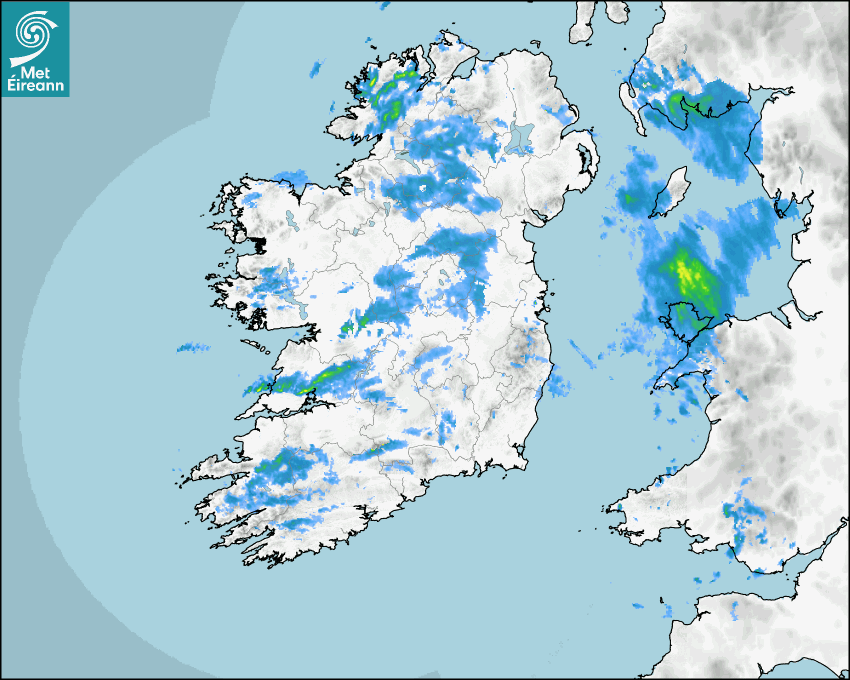

Latest Rainfall Radar showing live precipitation and the last 90 minutes precipitation over Ireland, updated every 5 minutes. Precipitation can be rain, hail or snow. Accumulations can refer to rainfall only.
Lightning strikes, when they occur, are displayed as a cross. Initially, they are red but change to orange and then yellow after a period, then disappear © Met Office ATDNet.
Ground Clutter may appear (South Co. Dublin), bright bands and spokes may also be present in images. They are artefacts (false echoes) of rainfall radar systems and should be ignored. Further information on Radar here
Met Éireann forecasters manually produce the weather icons for midday and midnight to reflect the predicted major weather type for these times.
The rainfall forecast is direct model output from Numerical Weather Prediction models but is a guideline only. Rain refers to precipitation, which can be rain, sleet or snow. It forecasts how much rain will fall (in mm) hourly during the previous hour (accumulations), then in 3 hourly and finally 6 hourly accumulations up to 7 days. This service is based on data and products of the HARMONIE-AROME and the European Centre for Medium-range Weather Forecasts (ECMWF) models.
The wind is direct model output from Numerical Weather Prediction models but is a guideline only. It forecasts the strength of the wind (in knots and km/h) at 10m for the top of each hour, in hourly, then 3 hourly and finally 6 hourly intervals up to 7 days. The wind arrow tip points in the direction the wind is blowing and the tail length indicates wind strength. However, in the text forecast below, it is described as where it is blowing from. This service is based on data and products of the HARMONIE-AROME and the European Centre for Medium-range Weather Forecasts (ECMWF) models.
The temperature is direct model output from Numerical Weather Prediction models but is a guideline only. It forecasts air temperature on land and over sea in °C for the top of each hour, 3 hourly and finally 6 hourly intervals up to 7 days. Minus zero (-0) indicates values between 0 to -0.5°C. This service is based on data and products of the HARMONIE-AROME and the European Centre for Medium-range Weather Forecasts (ECMWF) models.
The Mean Sea Level Pressure (MSLP) is direct model output from Numerical Weather Prediction models but is a guideline only. It forecasts the MSLP in hecto Pascals (hPa) for the top of that hour initially in 3 hourly intervals, then 6 hourly. This service is based on data and products of the HARMONIE-AROME and the European Centre for Medium-range Weather Forecasts (ECMWF) models.
Réamhaisnéis Náisiúnta
27 October 2026 23:30
Anocht
Mainly dry with clear spells at first towards the southeast and east tonight with just isolated showers. Outbreaks of rain in the west and northwest will quickly become more widespread overnight, lingering in northern areas until morning but clearing to isolated showers and some clear spells elsewhere. Breezy with moderate to fresh and gusty west to southwest winds, stronger towards Atlantic coasts. Lowest temperatures of 6 to 11 degrees, coldest under the clear spells to the east early tonight.
Amárach
Mostly cloudy at first with outbreaks of rain in the north clearing through the morning as sunny spells develop. Most areas will see a dry day with just the chance of the odd isolated light shower. Highest temperatures of 13 to 15 degrees with moderate to fresh southwesterly winds in the morning, decreasing light to moderate and becoming southerly later.
Met News
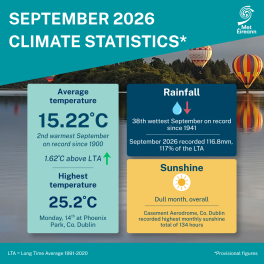
02a Deaireadh Fómhair 2026
Provisionally second warmest September on record for Ireland
September 2026 was provisionally the second warmes... léigh níos mó

25ú Meán Fómhair 2026
Met Éireann marks 90 years by looking to the future of meteorology and climate science
Met Éireann’s 90th Anniversary Conference broug... léigh níos mó
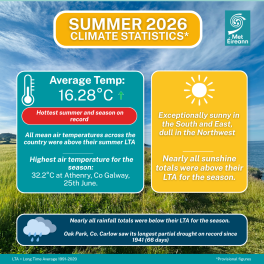
03ú Meán Fómhair 2026
Climate Statement for Summer 2026
Hottest summer on record for Ireland. Sunny and dr... léigh níos mó


