Eisíodh tuarascáil ar Staid na hAeráide Domhanda inniu de réir mar a “théann aeráid an Domhain as cothrom níos mó agus níos mó”.
Tuairiscíonn an Eagraíocht Dhomhanda Meitéareolaíochta (EDM) go bhfuil aeráid an Domhain as cothrom ar scála níos mó ná a taifeadadh riamh, agus tá gáis ceaptha teasa ina gcúis le téamh, cailliúint oighir agus tionchair bhuana a bheidh ann ar feadh na gcéadta bliain. Eisíodh an phríomhthuarascáil de chuid EDM ar Staid na hAeráide Domhanda inniu, Lá Domhanda Meitéareolaíochta, ag a bhfuil an téama ‘an Lá Inniu a Bhreathnú, an Lá Amárach a Chosaint’. Áirítear leis an tuarascáil ar Staid na hAeráide Domhanda, 2025 ionchur eolaíoch a gcuireann na scórtha Comhaltaí, comhpháirtithe agus eolaithe de chuid EDM léi, agus Éire san áireamh.
“Le breathnuithe trasna na hÉireann agus ar fud an domhain léirítear fós córas aeráide atá faoi bhrú, agus taifid á sárú nach bhfuil ina n-asluiteach ach mar chuid de threocht leanúnach lena n-athmhúnlaítear bonnlínte comhshaoil agus leibhéil riosca” a dúirt an Dr Sarah Gallagher, Ceann na Rannóige Breathnuithe, Met Éireann.
“Táthar ag iarraidh eolas a dhéanamh do chinnteoireacht le tuarascáil EDM ar Staid na hAeráide Domhanda. Tá sé ag teacht le téama an Lae Dhomhanda Meitéareolaíochta mar go gcosnaímid an lá amárach nuair a bhreathnaímid inniu, seachas an aimsir a thuar amháin. Daoine an Lae Amárach. Pláinéid an Lae Amárach,” a dúirt Ard-Rúnaí EDM, Celeste Saulo..
Príomhthorthaí Domhanda:
- Lean Gáis Ceaptha Teas de bheith ag ardú agus bhí buaicphointe in 2024 nach raibh le feiceáil le 2 mhilliún bliain chomh maith leis an méadú CO₂ ab airde ó bhí 1957 ann, a raibh astaíochtaí iontaise agus linnte carbóin ní ba laige ina gcúis leo.
- Shroich cion teasa aigéin (0-2000 m) an leibhéal ab airde riamh in 2025, rud a sháraigh 2024, agus tá na leibhéil is airde riamh á mbaint amach gach bliain ó bhí 2017 ann.
- D’fhan leibhéal na farraige gar don leibhéal ceánna a bhí ann in 2024, ~11 cm os cionn an leibhéil in 1993.
- Lean pH dhromchla an aigéin de bheith ag laghdú, agus is dócha nach bhfuil a leithéid de na leibhéil ann le 26,000 bliain anuas ar a laghad.
- Ba í cailliúint na maise oighearshrutha ó oighearshruthanna tagartha an 5ú cailliúint ba mheasa ar taifead.
- Ba é mheánmhéid an mhuiroighir Artaigh in 2025 an méid ab ísle nó an dara méid ab ísle ar taifead.
- Tá neamhshlándáil an tsoláthair bia arb í an aeráid is cúis léi ina riosca atá ag fás agus tá tionchair chascáideacha ar chobhsaíocht, imirce agus bithshlándáil.
- Bíonn tionchar ar níos mó ná aon trian den lucht saothair domhanda, timpeall 1.2 billiún duine, mar gheall ar thréimhsí teasa ceirde gach bliain.
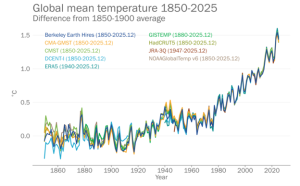
Aimhrialtachtaí sa mheánteocht bhliantúil dhomhanda i gcoibhneas le bonnlíne réamhthionsclaíoch (1850–1900)Is as na tacair sonraí a léirítear san eochair eolais atá na sonraí.
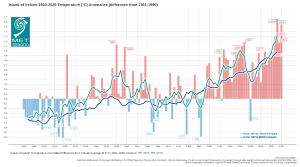
Aimhrialtachtaí i meánteocht oileán na hÉireann i gcoibhneas le bonnlíne 1961-1990 in éineacht le meáin rollacha 5 bliana d’Éirinn agus sonraí Domhanda
Cén fáth a bhfuil breathnuithe ag teastáil uainn?
Tá gach freagairt agus gach cinneadh bunaithe ar bhreathnuithe. Cabhraíonn sonraí aimsire agus aeráide linn tuiscint a fháil ar conas atá aeráid na hÉireann ag athrú agus cruinneas na réamhaisnéisí agus na rabhadh a fheabhsú. Le taifid fhadtéarmacha ar an aeráid léirítear conas atá teocht, báisteach agus stoirmeacha ag athrú, rud a chabhraíonn linn ullmhú d’aimsir chontúirteach ardtionchair.
- Deimhnítear i dtuarascáil EDM ar Staid na hAeráide gurb iad na blianta 2015-2025 na 11 bhliain is teo ar taifead.
- Deimhnítear in anailís Met Éireann gurb iad na blianta 2015-2025 na 11 bhliain ba theo ar taifead d’Éirinn freisin.
- Ba í an bhliain 2025 an dara bliain nó an tríú bliain ba theo ar taifead ar fud an domhain.
- Ba í an bhliain 2025 an dara bliain ba theo ar taifead in Éirinn agus bhí meánteocht 11.14 °C ann.
- Is iad na ceithre bliana deireanacha (2022 go 2025) na blianta is teo ar taifead d’Éirinn.
Tá Ráiteas 2025 ar Aimsir agus ar an Aeráid san Am atá Caite ar fáil ag Ráiteas Aeráide Bliantúil le haghaidh 2025.
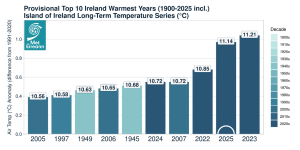
Na 10 mBliana Shealadacha Is Teo d’Éirinn (1900-2025 san áireamh)
Cén chaoi a n-oibríonn an córas breathnóireachta?
Tá taifead aeráide na hÉireann bunaithe ar mheascán de líonraí breathnóireachta dromchla náisiúnta agus de shruthanna sonraí comhroinnte idirnáisiúnta a chomhordaítear tríd an Eagraíocht Dhomhanda Meitéareolaíochta. Áirítear leo siúd stáisiúin talún ina dtomhaistear teocht, frasaíocht, gaoth agus brú, chomh maith le sondálacha aeir uachtair lena ngabhtar struchtúr ceartingearach an atmaisféir.
- Le Stoirm Éowyn bhí na gaotha ab airde a taifeadadh in Éirinn agus bhí séideáin suas le 184 km/u ag Ceann Mhása.
- Ba é an teocht ab airde sa bhliain (agus gach stáisiún oifigiúil eile de chuid Met Éireann san áireamh) 32.2 °C, a tuairiscíodh ag Páirc Náisiúnta Chonamara Dé Domhnaigh an 13 Iúil 2025
- Taifeadadh teochtaí a bhí chomh híseal le −7.6 °C ag Baile Átha an Rí i rith mhí Eanáir.
Comhordaítear bailiú, comhroinnt, próiseáil agus seachadadh na sonraí aimsire, aeráide agus hidreolaíocha go domhanda le cláir amhail Faire Aimsire Domhanda na hEagraíochta Domhanda Meitéareolaíochta.
In Éirinn, tá breathnuithe aimsire agus aeráide bunúsach dár gcuid oibre, ó réamhaisnéisí laethúla go rianú fadtéarmach na haeráide, agus is é Met Éireann a choinníonn iad sin go léir.
Le líonra stáisiún ar fud na tíre , ó láithreáin shionoptacha go dtí na céadta tomhsaire báistí, gabhtar an aimsir an-athraitheach in Éirinn agus cuirtear go díreach le réamhaisnéisí agus le léargais aeráide. I bhfad in airde os cionn Dhairbhre, rianaítear athruithe tríd an atmaisféar le balúin aimsire a sheoltar faoi dhó gach lá, rud a chabhraíonn le réamhaisnéiseoirí tuiscint a fháil ar chórais Atlantacha a thagann isteach sula dtiocfaidh siad . Tacaíonn gach breathnú le seachadadh réamhaisnéisí agus rabhadh tráthúil, rud a chabhraíonn le pobail ullmhú don aimsir ardtionchair.
Leis an tionscadal AISTRIGH (TRANSLATE) de chuid Met Éireann soláthraítear na chéad-réamh-mhéastacháin chaighdeánaithe aeráide d’Éirinn agus tá sé mar bhonn taca faoin gCreat Náisiúnta um Sheirbhísí Aeráide, rud a dhéanann faisnéise phraiticiúil faoin aeráide de bhreathnuithe, faisnéis a bhfuil tionchar aici ar chinnteoireacht fhadtéarmach ar fud earnálacha iomadúla.
In éineacht le hoibríochtaí aimsire domhanda, rianaítear gáis ceaptha teasa, truailleáin aeir agus riocht an chisil ózóin leis an bhFaire Atmaisféir Dhomhanda chun faireachán a dhéanamh ar athruithe ar an atmaisféar. Ag Stáisiún Taighde Atmaisféir Cheann Mhása, déanann Met Éireann faireachán ar gháis ceaptha teasa, aerasóil agus truailleáin aeir mar chuid de líonraí idirnáisiúnta, rud a sholáthraíonn breathnuithe fadtéarmacha ar chomhdhéanamh an atmaisféir thar an Atlantach Thuaidh.
An bhearna i mbreathnuithe a dhúnadh
Tá sé ríthábhachtach breathnuithe domhanda a neartú agus a leathnú chun réamhaisnéisí, rabhaidh agus athléimneacht i leith an athraithe aeráide a fheabhsú ar fud an domhain. Maidir le hÉirinn, tá bearnaí i mbreathnuithe domhanda tábhachtach toisc go bhforbraíonn ár n-aimsir thar an Atlantach.
- Bhí báisteach bhliantúil idir 804.2 mm ag Aerfort Bhaile Átha Cliath agus 1809.4 mm ag Réadlann Dhairbhre, rud a léirítear difríocht mhór réigiúnach agus an tábhacht a bhaineann le clúdach líonra.
- Bhí líon na laethanta báistí idir 184 lá ag Aerfort Bhaile Átha Cliath agus 258 lá ag Baile Uí Fhiacháin.
- Bhí báisteach bhliantúil idir 86% agus 124% den mheán fadtéarmach ar fud stáisiúin éagsúla.
An Lá Amárach a Chosaint
Tá breathnuithe cruinne, réamhaisnéisiú láidir, teicneolaíocht nua agus infheistíocht i ndaoine ag oibriú le chéile chun riosca a laghdú agus daoine, geilleagair agus an pláinéad a chosaint san am atá romhainn. Maidir le hÉireann, tá feabhsú réamhaisnéisí agus córas rabhaidh agus neartú pleanála ag baint leis sin de réir mar a éiríonn an tír níos teo, níos fliche agus níos nochta do bháisteach fhoircneach agus d’ardú ar leibhéal na farraige.
- Bhuail cúig stoirm ainmnithe Éire in 2025. Ba í Éowyn a tháinig ar dtús i mí Eanáir nuair a bhí gaotha ann nach raibh a leithéid le feiceáil riamh, Floris i mí Lúnasa, Amy i mí Dheireadh Fómhair, Claudia i mí na Samhna agus Bram ag an deireadh i mí na Nollag.
- B’ionann an bháisteach laethúil ab airde in 2025 agus 66.9 mm ag Caisleán Bhaile Sheáin Dé hAoine an 14 Samhain i rith Stoirm Claudia. B’ionann an bháisteach laethúil chlíomeolaíochta ab airde (09-09 AUL) agus 108.4 mm ag Locha Chluain Í, Co. Chiarraí Dé Sathairn an 5 Meán Fómhair 2025.
Tacaíonn breathnuithe ó bhlianta amhail 2025 le réamhaisnéisí níos fearr agus rabhaidh thráthúla maidir le haimsir ardtionchair, rud a chabhraíonn le daoine agus bonneagar a chosaint . Tá taifid fhadtéarmacha aeráide mar threoir ag cinntí de réir mar a thagann athrú ar Éirinn agus atá an tír níos nochta d’aimsir fhoircneach san am amach romhainn.