D’fhill an t-eolaí aeráide agus an taighdeoir, an Dr Tido Semmler, de chuid Met Éireann, ar thalamh tirim le déanaí tar éis seala ar feadh míosa ar bord an bhristeora oighir Ghearmánaigh, Polarstern.
23 Nollaig 2025
Ghlac Dr Semmler páirt i dturas taiscéalaíochta PS151 Polarstern, a chuir chun farraige ó Bremerhaven, an Ghearmáin i lár mhí na Samhna, agus a tháinig chun deiridh i gCuan Walvis, an Namaib níos luaithe an mhí seo.
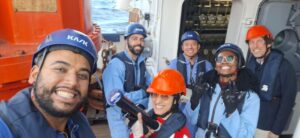
An Dr Tido Semmler, i bhfad ar dheis, le comhrannpháirtithe i dturas taiscéalaíochta PS151 Polarstern. Sonraí an ghrianghrafadóra – Caio Ribeiro
D’eagraigh Institiúid Alfred Wegener, Ionad Helmholtz um Thaighde Polach agus Muirí, an turas taiscéalaíochta, a dearadh go háirithe chun taithí phraiticiúil agus oiliúint a thabhairt do thaighdeoirí luathghairme maidir le conas an t-aigéan a fheiceáil, a thuiscint agus a shampláil.
Bhí Met Éireann ar cheann de na hinstitiúidí comhpháirtíochta – in éineacht le hOllscoil na Gaillimhe, Ollscoil Eolaíochta agus Teicneolaíocha Shahjalal sa Bhanglaidéis agus Ollscoil Bremen, an Ghearmáin – sa chlár, a bhí faoi stiúir Karen Wiltshire ó Choláiste na Tríonóide, Baile Átha Cliath.
Bhí an Dr Semmler i measc grúpa saineolaithe ar leith a bhí ina múinteoirí sinsearacha do na mic léinn maidir le croíréimsí taighde aigéaneolaíochta, lena n-áirítear an Samplóir Uisce CTD Rosette, sainaithint planctón, próifíliú colúin uisce, samhaltú aeráid an aigéin agus bailiú sonraí fíor-ama trí úsáid a bhaint as breathnuithe satailíte agus as córas uathoibrithe na loinge.
Chomhroinn foirne breise ar bord tomhais bhataiméadracha agus atmaisféaracha, agus é mar aidhm acu an oiliúint idirdhisciplíneach a shaibhriú agus béim acu go léir ar mhíniú a thabhairt ar conas an eolaíocht a phlé go grinn agus ar conas téamh tapa an aigéin a thuiscint agus a chur in iúl.
Ceann de na buaicphointí sa chlár i mbliana ná tabhairt isteach ‘The Dance of the Carbon Cycle,’ úrscéal agus gníomhaíocht oideachasúil agus shiamsúil a cuireadh ar fáil mar oiliúint ar bord chun cabhrú le míniú a thabhairt ar conas a chuireann astaíochtaí breosla iontaise isteach ar chothromaíocht nádúrtha an charbóin ar an Domhan, rud is cúis leis an athrú aeráide.
Trí ghluaiseacht, scéalaíocht agus eolaíocht, d’fhoghlaim rannpháirtithe an chaoi ar cheart do charbón dul timpeall, agus an méid a tharlaíonn nuair a ró-ualaíonn gníomhaíochtaí an duine an córas. Tar éis an uirlis teagaisc seo ar leith a chomhroinnt le comhghleacaithe sa Namaib, is é an plean ná an ‘damhsa’ a thabhairt isteach i seomraí ranga agus i bpobail ar fud an domhain .
I mbliana tugadh isteach conair oiliúna nua do mhúinteoirí ionchasacha freisin, atá dírithe ar litearthacht agus oiliúint faoin aigéan a neartú ar fud na cruinne.
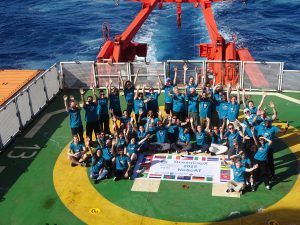
Grianghraf grúpa de rannpháirtithe i dturas taiscéalaíochta PS151 Polarstern. Sonraí an ghrianghrafadóra – Petra Gössmann-Lange
Ag labhairt dó faoina eispéireas, dúirt an Dr Semmler: “Mar shamhaltóir aeráide, ba dheis iontach é seo chun tuiscint a fháil ar shonraí breathnaitheacha a thomhas ar an bhfarraige, agus an tábhacht a bhaineann le dlúthchomhar idir eolaithe aeráide breathnaitheacha agus eolaithe aeráide samhaltaithe.
“Mar dhuine de na múinteoirí sinsearacha, bhí sé tábhachtach dom freisin a bheith in ann oideachas faoin eolaíocht aeráide a thabhairt don chéad ghlúin eile agus dóibh siúd as tíortha faoi mhíbhuntáiste.”
Chun tuilleadh faisnéise a fháil faoi thuras taiscéalaíochta Polarstern agus obair Institiúid Alfred Wegener, tabhair cuairt ar: An tÁrthach Taighde agus an Bristeoir Oighir, Polarstern – Institiúid Alfred Wegener..