New names include several associated with Met Éireann’s history, as part of celebrations of the meteorological service’s 90th anniversary
Tuesday, 1st September 2026
Met Éireann, in partnership with the National Meteorological Services of the UK (Met Office) and the Netherlands (KNMI), has launched the new list of names for the 2026/27 storm ‘season’, which starts today and runs until 31st August 2027.
Of the list of 21 names, each of the national partners has contributed seven names. Met Éireann’s selection features four historically significant names in Austen, Evelyn, Kilian and Miriam, with three derived from a longlist of nominations proposed through a public campaign run last year in Heather, Laoise and Phelim.
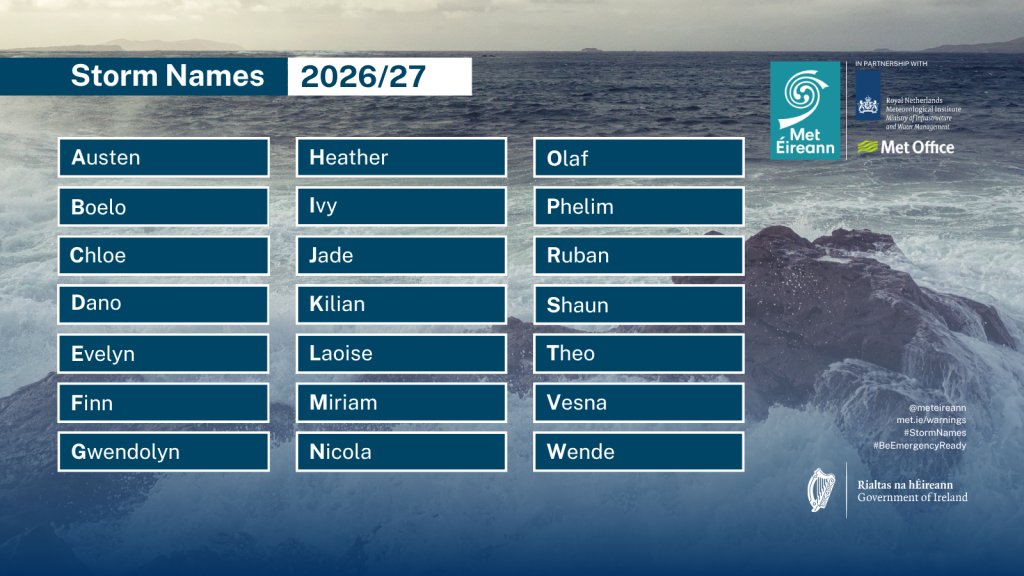
Fig 1 – Storm Names 2026/27
The full 2026/27 list is Austen, Boelo, Chloe, Dano, Evelyn, Finn, Gwendolyn, Heather, Ivy, Jade, Kilian, Laoise, Miriam, Nicola, Olaf, Phelim, Ruban, Shaun, Theo, Vesna, Wende.
(The names chosen by Met Éireann are in bold. Letters Q, U, X, Y, Z are not included, which is in line with the US National Hurricane Center naming convention).
Commenting on the launch, Eoin Sherlock, Head of Forecasting Division in Met Éireann, said:
“Naming storms helps Met Éireann in our mission to protect life and property through the provision of world-class weather, climate, and flood services. Using consistent names and communications allows us and other public safety organisations to increase awareness of severe and impactful weather alongside our weather warnings.
We know that naming storms makes it easier for people to track important and up to date forecast and safety-related information as we can see from the levels of traffic and activity through our website and across social media platforms during storm events.
2026 marks the 90th anniversary of the establishment of the Irish Meteorological Service and we are proud to be able to recognise some of the significant contributors to our history in the list of storm names this year, such as the first director of the Service in 1936, Austen Nagle, and the first woman to hold an operational role as a meteorological officer, Miriam Lyons.
As we approach the start of the new storm season, we take the opportunity to encourage to the public to engage with relevant forecasts and safety information during storms and all other extreme weather events.”
A storm is named when it could result in ‘medium’ or ‘high’ impacts in one of the three partner countries. Naming storms allows for authoritative and consistent communications with the public to enable them to prepare for, and stay safe, during potentially severe weather events.
When a storm is forecast, the national weather service that expects the biggest impact from the severe weather or is likely to be affected first, names the storm. As well as naming a storm, relevant orange/red warnings may be issued for wind, rain, or snow, or a combination of these conditions. Any warnings issued are based on a combination of numerical criteria and the potential impacts foreseen. Up to date information on all Irish weather forecasts and warnings can be found on the Met Éireann website and app.
Since 2015, Met Éireann and the UK Met Office have been working together on the naming programme, and they were joined by the Netherland’s KNMI in 2019.
Holly Clements, Head of Warnings and Guidance at the UK Met Office explained:
“For more than a decade, storm naming has helped us communicate the risks from severe weather more effectively. A named storm provides a clear focus for forecasts and warnings, helping more people understand the potential impacts and take action to protect themselves, their families and their property.”
Other National Meteorological Service groups in the US and Europe also name storms. When any National Met Service names a weather system, all others keep that name, including ex-hurricanes named by the US National Hurricane Center such as Charley (25th August 1986) and Ophelia (16th October 2017), which had major impacts in Ireland when they crossed the Atlantic.
Please Note:
For more information or interview opportunities with Met Éireann spokespersons, contact media@met.ie
Graphic material: Storm Names 2026/27 images from Met Éireann are available in different formats, please contact media@met.ie if you’d like to receive other formats.
About Storm Naming
Storm Names 2026-27 list
| Name | Nominating
met service |
Story behind the name/submission notes |
|---|---|---|
| Austen | Met Éireann | Austen H. Nagle (1903-1984) was the first director of Irish Meteorological Service, appointed in 1936. He worked in the British Meteorological Office from 1927 to 1936, and served as Director of the IMS until 1948, when he took up a senior post in the United States Weather Bureau. |
| Boele
(Boo-loh) |
KNMI | A nearly extinct name from East Groningen, Netherlands and a generational name submitted by members of the public. Also echoes in the Boelo Tijdens Kanaal, a canal on the eastern edge of the province of Groningen. |
| Chloe | UK Met Office | Chloe is nominated by her mum, who says her five-year old is “fascinated by the weather” and also “creates a storm by herself” when she is tired (Name nominated more than 130 times). |
| Dano | KNMI | Honoring professor Dano Roelvink, a coastal researcher at IHE Delft/Deltares and founder of Delft3D and XBeach — models that predict storm surges and dune erosion. His 2026 retirement is seen as a fitting moment. He’s described as brilliant, kind, and globally respected. |
| Evelyn | Met Éireann | Evelyn Murphy was first woman to work as a meteorologist in Met Éireann and the first woman meteorologist to present the forecast on RTÉ television in 1983. She went on to head the Marine Unit and led the creation of the Irish Marine Data Buoy Observation Network from 2000 with the launch of Marine Buoy 1 (M1). The Network provides critical observational information for weather forecasts including storms.
Evelyn Cusack was the first female head of forecasting at Met Éireann, and one of the longest-serving forecasters on RTÉ television. |
| Finn | UK Met Office | Finn – nominated by a mother who says her two-year-old son is wild! Finn is “Full of energy and has a real zest for life. Sometimes he’s affectionally named feral Finn, wild Finn, or Finn the bin, because he’s a force to be reckoned with!” |
| Gwendolyn | KNMI | Gwendolyn nominates her own name, inspired by a childhood memory: as a kid, her mother’s friend told her (to motivate her to tidy up) that the KNMI names storms after children with the messiest rooms. As an autistic girl, she took this literally and became messier instead, hoping to eventually earn that honor. The storm never came, but she now hopes her childhood efforts will finally pay off. She also mentioned her birthday falls on September 1st. |
| Heather | Met Éireann | Taken from the list of names submitted by members of the public in Ireland in 2025. |
| Ivy | UK Met Office | Ivy is a 9-month-old labrador puppy who is “the absolute destructor, but also most loving pup. She deserves a name too!” |
| Jade | KNMI | Jade was submitted 549 times in tribute to Jade Kops from ‘s-Gravenzande, who died of cancer at age 19. Submitters often link her illness to the storm metaphor and note her positivity despite a terminal diagnosis. Many mention her fundraising for the Princess Máxima Center and Stichting Jade/Villa Jade, as well as her fame as an influencer. Most entries are short: “in memory of” or “for Jade Kops.” |
| Kilian | Met Éireann | P. Kilian Rohan (1916-1999) was director of the Irish Meteorological Service from 1978 to 1981. He joined the Irish Meteorological Service in 1940, and over his career was involved in international aeronautical meteorology and climatology. He wrote the first authoritative description of the Irish climate, The Climate of Ireland (1976). Rohan led the move of the IMS to its new headquarters in Glasnevin in 1979. |
| Laoise
(Lee-sha) |
Met Éireann | Taken from the list of names submitted by members of the public in Ireland in 2025. |
| Miriam | Met Éireann | Miriam Lyons, first woman to work in Met Éireann as an operational Meteorological Officer in 1978. She was also the first Irish woman to fly in a jet fighter when posted in Casement Aerodrome. |
| Nicola | UK Met Office | Nicola – nominated “For my mum who has weathered many a storm and only come out stronger. |
| Olaf | KNMI | Olaf is nominated in honor of a close friend of the submitter who died at age 44. He was passionate about weather and the universe, loved going outside during storms to observe them (sharing his experiences on Facebook), and wrote many Wikipedia pages on the topic. Despite a progressive muscular disease, he made the most of life. After his death, the submitter promised to think of him during every storm. |
| Phelim
(Fay-lim) |
Met Éireann | Taken from the list of names submitted by members of the public in Ireland in 2025. |
| Ruban | UK Met Office | Nominated by a mother to reflect the diversity of communities across the UK. |
| Shaun | UK Met Office | After Shaun the Sheep, voted for by the UK public and part of a collaboration with Aardman. |
| Theo | UK Met Office | Named after a cat called Theo, who became frightened and hid before thunderstorms, leading his owner to joke that he could predict the weather. |
| Vesna | KNMI | Vesna is nominated after the submitter’s Croatian colleague, due to her clearly southern temperament. She’s described as impulsive, with fierce outbursts — making a storm named after her, a fitting match, according to the submitter. |
| Wende
(Vhen-duh) |
KNMI | Wende was chosen for its connection to the vanished village of De Westen on the Dutch island Texel, once one of the island’s oldest settlements. Tradition links that disappearance to outside violence and storm and water. The submitter feels the name evokes loss, reversal, and the power of the weather, while also referencing an almost-forgotten piece of Texel’s history. |
Once again we extend our thanks to the Irish public for their enthusiasm and activity around the call for name suggestions in 2025. We hope to be able to use that list for further inspiration on storm names in the years to come.
Storm season 2025/26 overview
In the season just ending (2025/26), there were five* named storms affecting the area, starting with Amy in October 2025, and featuring Claudia (November), Bram (December), Chandra (January) and finally, Dave (April). *Note – Storm Claudia was named by the Spanish Meteorological Agency (AEMET) which forms part of the south-western Europe naming convention, also incorporating Portugal and France.
Overall, the season was characterised by strong Atlantic cyclones, with the most extreme wind conditions in October, the lowest pressure in January, the greatest rainfall in November and the final listed storm impact occurring in April. Every storm of the season brought its own mix of extreme and challenging weather to Ireland, from violent winds and exceptional waves to heavy rainfall and unusually high December temperatures during a storm.
- Storm Amy was the most severe wind event, bringing violent storm force sustained winds of 111 km/h and gusts reaching 148 km/h at Malin Head.
- Storm Claudia was less severe for wind but was the wettest event, producing a daily rainfall total of 66.9 mm at Johnstown Castle. Claudia also generated the highest individual wave of the season at 21.1 m at Buoy M5 off the south Wexford coast.
- Storm Bram was an unusually warm December storm with temperatures up to 17.2 °C at Phoenix Park.
- Storm Chandra was the deepest storm in the season, with mean sea level pressure falling to 958.4 hPa. Chandra also produced gusts of 130 km/h at Malin Head, making it the second strongest wind event after Amy.
- Storm Dave in early April was the last-named storm of the season, bringing storm force winds, gusts of 111 km/h and 38.6 mm of daily rainfall.
Irish storms in the past
- Across 11 seasons since the storm naming initiative began in 2015/16, there have been 87 storms observed and there has been high variability in the number of storms observed each season since then.
- The highest number of named storms affecting Ireland in a single season was fourteen, during 2023/24. However, 2015/16 remains the season with the greatest number reaching Storm Force 10 or higher, when nine of the 11 named storms produced sustained winds of Storm Force 10 or greater at coastal stations.
- The lowest number of storms affecting Ireland since the storm naming initiative began was four, during the 2022/23 season.
- The last hurricane force winds observed on land for Ireland were during Storm Éowyn on Friday 24th January 2025 with gusts up to 184 km/h. This was the strongest gust speed ever recorded in Ireland, breaking the previous record of 182km/h set at Foynes, Co. Limerick in 1945.
For more information on storm names and past extreme weather records, see Storm Centre and Major Weather Events.
About Met Éireann’s Warning Services – what you need to know

Fig 3 – Met Éireann’s weather warning icons (from left to right):
Advisory, Small Craft Warning, Yellow, Orange and Red warnings icons for land and marine warnings
- Weather warnings issued by Met Éireann are based on a combination on numerical criteria for wind, rain, temperature, etc. and the potential impacts of the foreseen hazardous conditions.
- Met Éireann’s app and website (https://www.met.ie/warnings/today) have a 3-day tab map displaying all warnings, which could be issued up to three days ahead. This allows clearer communication and understanding of the complex weather scenarios which can affect Ireland, especially in winter.
- The Met Éireann app provides an option to subscribe to receive push notifications of weather warnings for a chosen county, selected counties or all counties.
- Met Éireann also offers a subscription for weather warnings emails, via https://www.met.ie/warnings/login
- The ‘warnings’ page on met.ie and the app also features warnings for Northern Ireland, whenever they are issued by the UK Met Office. This provides a clear, authoritative one-stop shop for easy and reliable access to the latest weather warnings for the island of Ireland.
- Warning explanations can be found here: https://www.met.ie/weather-warnings
Impacts of storms/severe weather
- The timing and location of extreme weather occurrences can significantly affect the impact it may have on society and/or the economy.
- In any individual weather event, not every location within a warning area may experience the same degree of weather or impacts.
- When severe weather is expected, weather and impacts at lower levels are also likely to be experienced. The type and amount of impacts can be strongly affected by previous weather conditions. Met Éireann takes into consideration the forecasted conditions and thresholds as well as previous weather conditions that may increase the level of impact expected for particular areas when issuing a warning.
Get the latest forecast under severe weather conditions
- For the most accurate and up to date forecast for your area on the Island of Ireland go to www.met.ie.
- Warnings – For the latest weather advisories and warnings for Ireland go to: https://www.met.ie/warnings/today
- These services and much more are available on our free Met Éireann app – available from the App store for iPhone and from Play Store for Android.
Met Éireann digital channels analytics during severe weather
- A growing number of the public access information on weather warnings and updates through social media as well as radio and television. This is heightened with the use of colour coded warnings and the storm naming initiative, which reinforces how useful it is for Met Éireann’s communications.
- The Met Éireann website and app see a marked rise in engagement just before and during a named storm. The average daily page views on our website, when there are no named storms, is approximately 150k daily page views. In comparison, as shown in the graph below, this increases in the lead up to and during a named storm. For example, the day before Storm Bram impacted Ireland, page views on our website jumped to 909k, and then increased to 1.12m views on the day of the storm (9th December 2025), and other examples from previous years are as shown in the image. Also, our Met Éireann app receives approximately an average of 300k daily sessions, which also increases to higher usage in storm events, the session total the day before and during Storm Bram totalled just over 1m.
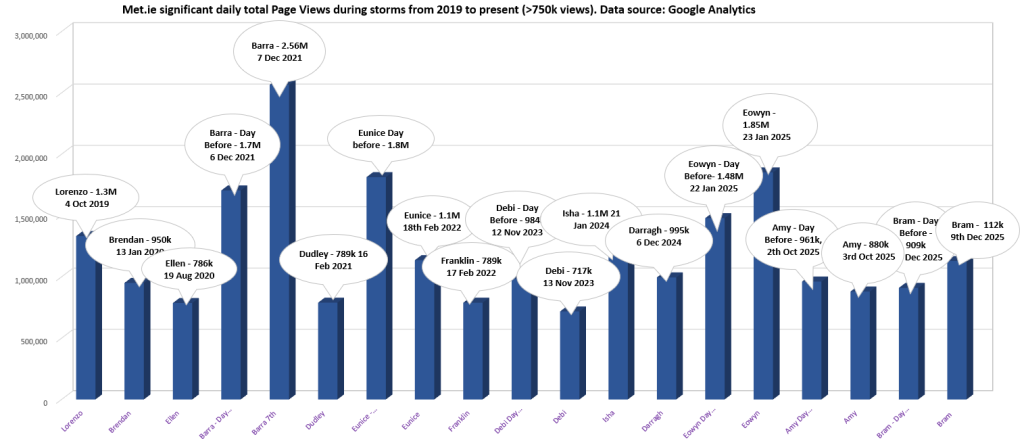
Fig 3 – Graph showing number of page views on Met Éireann website during significant storm events since 2019. Data source: Google Analytics