Tá an Eoraip ag téamh a dhá oiread níos tapa ná an meán domhanda, de réir na tuarascála bliantúla is déanaí ó Sheirbhís Copernicus um Athrú Aeráide (C3S) de chuid an Lárionaid Eorpaigh um Réamhaisnéisí Meántéarmacha Aimsire (ECMWF) agus ón Eagraíocht Dhomhanda Mheitéareolaíochta (WMO).
Leagtar amach i dtuarascáil European State of the Climate (ESOTC) 2025 gur chuir an téamh tapa ar fud na mór-roinne anuraidh laghdú suntasach ar chlúdach sneachta agus oighir, tonnta teasa ba mhó riamh ar tír agus ar muir, triomach, falscaithe agus caillteanas leanúnach bithéagsúlachta.
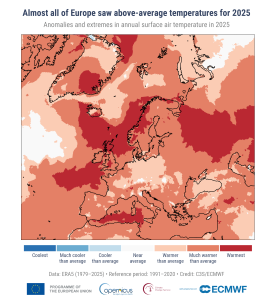
Aimhrialtachtaí agus aertheocht bhliantúil ag dromchla an domhain a mbaineann rótheas agus don rófhuacht leis in 2025. Tá na catagóirí foircneacha (‘is fuaire’ agus ‘is teo’) bunaithe ar ranguithe don tréimhse 1979-2025. Léiríonn na catagóirí eile an chaoi a gcuirtear na teochtaí i gcomparáid lena ndáileadh le linn na tréimhse tagartha 1991-2020. ‘I bhfad níos fuaire/níos teo ná an meán’ – níos fuaire/níos teo ná 90% de na teochtaí; ‘Níos fuaire/níos teo ná an meán’ – níos fuaire/níos teo ná 66% de na teochtaí; ‘Gar don mheán’ – laistigh den 33% lárnach
Tugann an tuarascáil le chéile obair na seirbhísí meitéareolaíochta náisiúnta, institiúidí taighde agus oideachais, agus rannpháirtithe eolaíochta eile chun léargas cuimsitheach a thabhairt ar na príomhathruithe i dtáscairí aeráide ar fud na hEorpa.
I measc na foirne eagarthóireachta a d’oibrigh thar ceann na hEagraíochta Domhanda Meitéareolaíochta (WMO) ar thuarascáil na bliana seo bhí an Dr Claire Scannell, Príomhoifigeach Meitéareolaíochta agus Ceannaire an tionscadail TRANSLATE i Met Éireann.
D’oibrigh an Dr Scannell ar an gcuid dar teideal ‘Beartas agus Gníomhú ar son na hAeráide: Bithéagsúlacht’, inar míníodh gur cúis mhór í an t-athrú aeráide le meath bithéagsúlachta na hEorpa, agus cé go bhfuil torthaí dearfacha á mbaint amach ag gníomhaíochtaí beartais agus creatlaí, tá an dul chun cinn mall.
Mhínigh an Dr Scannell: “Tá dlúthcheangal idir an t-athrú aeráide agus an bhithéagsúlacht, agus tá aeráid athraitheach na hEorpa ag cur isteach ar thimpeallachtaí nádúrtha talún agus mara a mór-roinne.
“Laghdaíonn an meath seo ar an mbithéagsúlacht cumas an dúlra an aeráid a rialáil agus dul in oiriúint don athrú aeráide, rud a chruthaíonn timthriall treisithe. Tá sé ríthábhachtach aghaidh a thabhairt ar dhúshláin an athraithe aeráide agus an meath atá ar an mbithéagsúlacht ar bhealach comhordaithe, agus léirítear é sin i mbeartais agus i gcreatlacha na hEorpa.”
Léirítear sa tuarascáil freisin go raibh teochtaí bliantúla os cionn an mheáin ag 95% ar a laghad den Eoraip in 2025. Bhí Éire ina measc, agus ba í seo an dara bliain ba theo riamh á taifead aici, agus an mheánteocht bhliantúil beagnach 1 °C os cionn an fhigiúir fhadtéarmaigh don tréimhse 1991-2020.
I measc na bpríomhthorthaí eile, ba í meánteocht bhliantúil dhromchla na farraige don réigiún Eorpach an teocht ba airde a ndearnadh taifead riamh uirthi, bhí níos báistí agus tuilte foircneacha go forleathan ná mar a bhí le blianta beaga anuas agus bhí sreabhadh aibhneacha ar fud na hEorpa faoi bhun an mheáin ar feadh 11 mhí den bhliain.
Tá an tuarascáil iomlán ar fáil anseo:European State of the Climate 2025 | Copernicus
Is féidir ceisteanna breise faoin tuarascáil ESOTC 2025 nó faoin dearcadh Éireannach ar a torthaí a sheoladh chuig media@met.ie.