Te agus fliuch. Thug an cruinneachán teasa tonnta teasa agus teochtaí an-ard isteach leis
Mar thoradh ar chruinneachán teasa a forbraíodh os cionn iarthar na hEorpa, bhí tréimhse ann in Éirinn i dtreo dheireadh na míosa seo caite a bhí neamhghnách te agus tais, agus taifeadadh líon suntasach teochtaí a sháraigh na teochtaí ab airde a taifeadadh roimhe seo ar fud na tíre. Ar an iomlán, taifeadadh an íosteocht ab airde riamh ag naoi gcinn de na 25 príomhstáisiún aimsire de chuid Met Éireann idir an 25 agus an 26 Meitheamh, agus taifeadadh an uasteocht ab airde riamh ag sé stáisiún. Mar thoradh ar na coinníollacha eisceachtúla, taifeadadh an tríú agus an ceathrú cás riamh d’oíche thrópaiceach* (íosteocht thar oíche os cionn 20 °C) ag príomhstáisiún aimsire in Éirinn ag Baile an Phaghanaigh i gContae Cheatharlach agus ag Aeradróm Mhic Easmainn i gContae Bhaile Átha Cliath ar oíche an 25 Meitheamh.
Príomhfhigiúirí míosúla:
- Bhí mí an Mheithimh 2026 thar a bheith te, agus meánteocht 15.33 °C ann; tá sé sin 1.65 °C os cionn an mheáin fhadtéarmaigh (MFT) do na blianta 1991-2020 agus 2.11 °C os cionn an MFT do na blianta 1961-1990.
- De réir figiúirí sealadacha, ba é mí an Mheithimh 2026 an ceathrú mí Mheithimh ba theo le 127 bliain anuas (ó 1900 i leith).
- Tharla sé cinn de na deich mí Mheithimh ba theo ó 2001 i leith.
- Taifeadadh an mhí Mheithimh ba theo riamh (1900-2026) ag Páirc an Fhionnuisce (ceann de na stáisiúin fhadbhunaithe i dtacar sonraí Oileán na hÉireann*).
- Sháraigh trí stáisiún déag (agus chothromaigh stáisiún amháin) an uasteocht is airde a thaifead siad do mhí an Mheithimh, agus sháraigh sé cinn acu sin an uasteocht is airde a thaifead siad riamh freisin.
- Sháraigh seacht stáisiún déag a íosteocht ab airde a thaifead siad riamh do mhí an Mheithimh (09-09*) agus sháraigh naoi gcinn acu sin (agus chothromaigh dhá cheann) an íosteocht ab airde a thaifead siad riamh (09-09).
- Bhí oíche thrópaiceach ag dhá stáisiún (Baile an Phaghanaigh agus Aeradróm Mhic Easmainn) (09-09 a chríochnaigh Dé hAoine an 26ú lá).
- Bhí tonnta teasa* ag trí stáisiún (Baile an Phaghanaigh; an Chloch Liath, Co. Chorcaí; agus an Goirtín, Co. Thiobraid Árann) idir Dé Luain an 22ú lá agus Dé hAoine an 26ú lá.
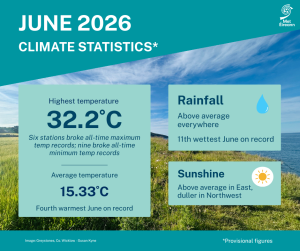
Buaicphointí Ráitis Aeráide le haghaidh mhí an Mheithimh.
Bhí mí an Mheithimh 2026 te agus fliuch go leor, go ginearálta. Thug cruinneachán teasa ón deisceart teochtaí an-ard i rith an lae agus na hoíche, chomh maith le taise ard, i dtreo dheireadh na míosa.
Bhí tionchar mór ag lagbhrú ón Atlantach ar an gcuid is mó de laethanta na chéad tréimhse den mhí; dá bharr sin, bhí báisteach fronta fhorleathan ann agus ceathanna eatarthu, agus ceathanna toirneacha uaireanta. Choinnigh aermhais mhuirí pholach an aimsir sách fionnuar i rith na tréimhse seo, go háirithe san Iarthar.
Sa dara trian den mhí, bhí streachailt ann idir ardbhrú ó dheas agus lagbhrú san iarthar, agus an teocht ag ardú de réir a chéile. Ar dtús, neartaigh an t-ardbhrú ó thuaidh agus bhí roinnt laethanta tirime ann, sula raibh frontaí aimsire gníomhacha ag gluaiseacht trasna na tíre de bharr an lagbhrú san iarthar i dtreo dheireadh na tréimhse.
Neartaigh an t-ardbhrú os cionn na tíre arís ag tús an triain dheireanaigh den mhí rud a d’fhág go raibh tréimhse níos tirime agus níos grianmhaire ann agus an teocht ag ardú ó lá go lá. Bhrúigh cruinneachán teasa, a bhí tar éis forbairt os cionn Iarthar na hEorpa, ó thuaidh os cionn na tíre agus ba é an toradh a bhí air ná tréimhse a bhí thar a bheith te agus tais idir an Luan an 22ú lá agus an Aoine an 26ú lá. Tharla dianstoirmeacha toirní in áiteanna Déardaoin an 25ú lá agus Dé hAoine an 26ú lá, sula ndeachaigh aermhais níos fionnuaire ón Atlantach trasna na tíre ón iarthar Dé Sathairn an 27ú lá. Le linn na laethanta deireanacha den mhí, tháinig na gnáth-theochtaí ar ais agus bhí báisteach nó ceathanna scaipthe ann, idirscartha le tréimhsí tirime.
Báisteach: Os cionn an mheáin i ngach áit; is tirime sa Deisceart
- Bhí an mhí Mheithimh ba fhliche ó 2002 i leith ag Béal an Mhuirthead, Co. Mhaigh Eo (127.5 mm, nó 174% den MFT).
- Bhí an mhí Mheithimh ba fhliche ó 2012 i leith ag cúig stáisiún (Páirc an Fhionnuisce, Aerfort na Sionainne, Aerfort Bhaile Átha Cliath, Marcréidh agus an Goirtín).
- Bhí an mhí Mheithimh ba fhliche ó 2013 i leith ag Aerfort Chorcaí, agus bhí an mhí Mheithimh ba fhliche ó 2016 i leith ag an Muileann gCearr.
Bhí na hiomláin bháistí go léir os cionn a Mheáin Fhadtéarmaigh 1991-2020 (MFT) don mhí. Bhí céatadán de na luachanna báistí míosúla idir 102% (b’ionann iomlán báistí ab ísle na míosa agus 70.5 mm) ag Rinn an Róistigh, Co. Chorcaí, agus 175% (127.5 mm) ag Béal an Mhuirthead, Co. Mhaigh Eo (an Meitheamh ba fhliche ann ó 2002 i leith). Bhí iomláin mhíosúla na titime báistí chomh hard le 143.6 mm (154% den MFT) ag Baile Uí Fhiacháin, Co. Mhaigh Eo. Ba é iomlán laethúil na titime báistí ab airde ná 26.8 mm ag Aerfort Chorcaí, Dé hAoine, an 5ú lá.
Bhí líon na laethanta báistí* idir 16 lá ag Baile an Phaghanaigh, Co. Cheatharlach agus 23 lá ag cúig stáisiún. Bhí líon na laethanta fliucha* idir 11 lá ag Baile an Phaghanaigh, Co. Cheatharlach agus Aerfort Bhaile Átha Cliath, Co Bhaile Átha Cliath go 21 lá ag Cionn Mhálanna, Co. Dhún na nGall. Bhí líon na laethanta a bhí an-fhliuch* idir 2 lá ag Baile an Phaghanaigh, Co. Cheatharlach agus 6 lá ag Aerfort na Sionainne, Co. an Chláir agus Aerfort Bhaile Átha Cliath. Taifeadadh an mhí Mheithimh ba fhliche ag cúig stáisiún (Páirc an Fhionnuisce i gContae Bhaile Átha Cliath, Aerfort na Sionainne i gContae an Chláir, Aerfort Bhaile Átha Cliath, Marcréidh i gContae Shligigh agus an Goirtín i gContae Thiobraid Árann) ó 2012 i leith; bhí an Meitheamh ba fhliche ó 2013 i leith ag Aerfort Chorcaí i gContae Chorcaí, agus bhí an Meitheamh ba fhliche ó 2016 i leith ag an Muileann gCearr i gContae na hIarmhí.
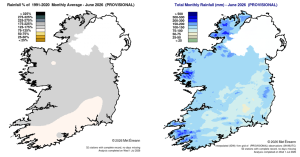
% Báisteach de 1991 – 2020 Meán Míosúil 2021 i mí an Mheithimh 2026 (Sealadach). Báisteach Iomlán Mhíosúil (mm) do Mheithimh 2026 (Sealadach).
Teocht: Os cionn an mheáin i ngach áit; taifeadadh na huasteochtaí agus na híosteochtaí aeir ab airde riamh do mhí an Mheithimh ag neart stáisiún
Bhí an mheánteocht aeir ar fud na tíre os cionn an MFT don mhí. Bhí athruithe idir an mheánteocht aeir idir +0.5°C (14.7°C) ag Baile Uí Fhiacháin, Co. Mhaigh Eo, agus +2.3°C ag Aerfort Bhaile Átha Cliath, Co. Bhaile Átha Cliath (meánteocht 15.6°C) (an dara Meitheamh ba theo riamh ar taifead, (fad taifid de 84 bliain)), agus ag Páirc an Fhionnuisce, Co. Bhaile Átha Cliath (meánteocht 16.2 °C) (an mhí Mheithimh ba theo a taifeadadh riamh (tréimhse 127 bliain)). Bhí meánteochtaí don mhí idir 13.7 °C (1.0 °C os cionn a MFT) ag Cionn Mhálanna, Co. Dhún na nGall agus 16.2 °C (2.3 °C os cionn a MFT) ag Páirc an Fhionnuisce.
Tuairiscíodh an teocht ab airde sa mhí i mBaile Átha an Rí, Contae na Gaillimhe, Déardaoin an 25ú lá, agus an teocht ag 32.2 °C (an uasteocht laethúil aeir ab airde d’aon mhí iomlán a taifeadadh (tréimhse 16 bliana)). Taifeadadh an teocht aeir agus an íosteocht féir ab ísle don mhí araon Dé Luain an 8ú lá ag Marcréidh, Contae Shligigh. Ba é 4.0 °C an íosteocht aeir, agus ba é -1.0 °C an íosteocht féir. Níor tuairiscíodh sioc aeir an mhí seo. Tuairiscíodh sioc talún ag níos lú ná leath na stáisiún. Bhí líon na laethanta a raibh sioc talaimh ann idir lá ar bith ag formhór na stáisiún agus lá amháin ag líon beag stáisiún.
Sháraigh trí stáisiún déag (agus chothromaigh stáisiún amháin) an uasteocht do mhí an Mheithimh is airde a thaifead siad, agus sháraigh sé cinn acu sin a uasteocht is airde a thaifead siad riamh freisin (féach tábla 1). Sháraigh seacht stáisiún déag an íosteocht ab airde a thaifead siad riamh do mhí an Mheithimh (09-09*) agus sháraigh naoi gcinn acu sin (agus chothromaigh dhá cheann) an íosteocht ab airde a thaifead siad riamh (09-09). Áirítear ar na stáisiúin a sháraigh na híosteochtaí ab airde a thaifead siad riamh roimhe: Aeradróm Mhic Easmainn, Co. Bhaile Átha Cliath (20.3 °C (an dara híosteocht ab airde a taifeadadh riamh ag stáisiún sionoptach, i ndiaidh an 20.5 °C a taifeadadh ag Dairbhre i mí Iúil 2021)), Baile an Phaghanaigh, Co. Cheatharlach (20.3 °C), Páirc an Fhionnuisce, Co. Bhaile Átha Cliath (19.8 °C), An Muileann gCearr, Co. na hIarmhí (19.6 °C), An Chloch Liath, Co. Chorcaí (19.6 °C), Dún Samhnaí, Co. na Mí (19.3 °C), Inis Arcáin, Co. Chorcaí (18.5 °C), an Goirtín, Co. Thiobraid Árann (18.3 °C), Cluain Creamha, Co. Ros Comáin (17.8 °C), Aerfort Bhaile Átha Cliath (19.1 °C (cothrom leis an teocht a taifeadadh ar 6 Meán Fómhair 2016)) agus Caisleán Bhaile Sheáin, Co. Loch Garman (19.0 °C (cothrom leis an teocht a taifeadadh ar ón 2 Lúnasa 1995)).
Bhí oíche thrópaiceach ag dhá stáisiún, Baile an Phaghanaigh agus Aeradróm Mhic Easmainn (09-09 a chríochnaigh Dé hAoine an 26ú lá). Chomhlíon trí stáisiún Baile an Phaghanaigh, an Chloch Liath agus an Goirtín critéir na dtonn teasa* idir Dé Luain 22 agus Dé hAoine 26.
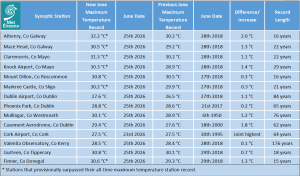
Tábla 1: Taifid uasteochta shealadacha nua i mí an Mheithimh do na príomhstáisiúin i gcomparáid le taifid mhí an Mheithimh do na stáisiúin roimhe seo. Sháraigh sé phríomhstáisiún na huasteochtaí is airde a bhí acu roimhe seo chomh maith.
Taitneamh Gréine: Os cionn an mheáin san Oirthear, níos gruama san Iarthuaisceart
Bhí na hiomláin taitnimh gréine a taifeadadh den chuid is mó os cionn an MFT don mhí. Bhí an céatadán de na luachanna míosúla taitnimh gréine idir 103% (169.8 uair an chloig) ag Aerfort na Sionainne, Co. an Chláir agus 122% (204.9 uair an chloig) ag Aeradróm Mhic Easmainn, Co. Bhaile Átha Cliath. Bhí na hiomláin mhíosúla taitnimh gréine ab ísle ag Béal an Mhuirthead, Co. Mhaigh Eo ag 122.1 uair an chloig (níl comparáid MFT ar fáil*). Ba é an líon ab airde uaireanta taitnimh gréine laethúil a taifeadadh an mhí seo ná 15.5 uair i gCionn Mhálanna, Co Dhún na nGall Dé Sathairn an 20ú lá. Bhí líon na laethanta gruama* idir 1 lá ag Aeradróm Mhic Easmainn, Co. Bhaile Átha Cliath go 6 lá ag Caisleán Bhaile Sheáin, Co. Loch Garman agus Réadlann Dhairbhre, Co. Chiarraí.
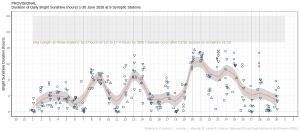
Uaireanta Faoi Iomlán Gréine a tugadh faoi deara ag gach stáisiún do gach lá de mhí an Mheithimh 2026, curtha le chéile de réir cúige i gcoibhneas leis an líon is airde uaireanta is féidir faoi dheireadh na míosa (bosca scáthlínithe).
Gaoth: Gálaí tuairiscithe ag stáisiún amháin
Bhí meánluasanna na gaoithe míosúla idir 5.8 muirmhíle san uair (10.7 km/u) i mBéal Átha hÉis, Co. an Chabháin agus 14.6 muirmhíle san uair (27.0 km/u) ag Ceann Mhása, Co. na Gaillimhe. Tuairiscíodh gálaí Dé Sathairn an 6ú lá, ag Rinn an Róistigh i gContae Chorcaí. Bhí líon na laethanta le gaotha fórsa gála idir lá ar bith ag an gcuid is mó de na stáisiúin go dtí lá amháin ag Rinn an Róistigh, Co. Chorcaí. Níor tuairiscíodh aon ghálaí ná stoirmeacha láidre an mhí seo. Tuairiscíodh go raibh séideán ab airde na míosa ag Inis Arcáin, Contae Chorcaí, Dé hAoine an 5ú lá agus ag Rinn an Róistigh, Contae Chorcaí, Dé Sathairn an 6ú lá le 44 muirmhíle (82 km/u). Ba é an luas gaoithe 10 nóiméad ab airde ná 37 muirmhíle san uair (69 km/u) a tuairiscíodh ag Rinn an Róistigh, Co. Chorcaí, Dé Sathairn an 6 Aibreán.
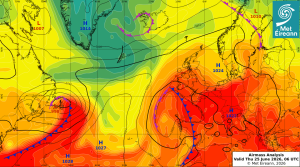
Cairt Anailíse Aermhaise 06 AUL 25 Meitheamh 2026: Bhí aermhais a bhí thar a bheith te agus tais tar éis bogadh thar Éirinn ón deisceart.
Tá tuarascáil iomlán PDF agus cairteacha ar fáil anseo.
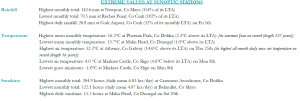
Luachanna foircneacha ag stáisiúin shionoptacha do Mheitheamh 2026.
Nótaí don Eagarthóir:
- Eisithe ag Met Éireann Déardaoin 2 Iúil 2026. Tá an tuarascáil seo bunaithe ar réamhshonraí atá ar fáil ó 25 príomhstáisiún aimsire arna n-oibriú ag Met Éireann. Is í meán oíche go meán oíche AUL an tréimhse a chlúdaíonn sonraí stáisiúin shionoptacha. Tagraíonn Meánleibhéil Fhadtéarmacha (MLFTanna) agus “meán” don tréimhse 1991-2020.
- Is lá báistí é lá le 0.2 mm nó níos mó de thitim báistí. Is lá fliuch é lá le 1.0 mm nó níos mó de thitim bháistí. Is lá gruama é lá le níos lú ná 0.5 uair an chloig de thaitneamh gréine. Is lá an-fhliuch é lá le 10.0 mm nó níos mó de thitim bháistí.
- Tréimhsí tirime aeráideolaíochta – Sainmhínítear dearbhthriomach mar shraith 15 lá as a chéile nó níos mó nach dtaifeadann aon lá aonair 0.2 mm nó níos mó de fhrasaíocht. Is é páirt-triomach tréimhse 29 lá nuair nach mó an mheántitim báistí laethúil agus ná 0.2 mm. Sainmhínítear tréimhse thirim mar thréimhse 15 lá as a chéile nó níos mó, nach bhfaigheann aon cheann acu 1.0 mm nó níos mó de fhrasaíocht (i.e., an t-iomlán laethúil níos lú ná 1.0 mm).
- Tarlaíonn tonn teasa nuair a bhíonn 5 lá as a chéile nó níos mó ann a bhfuil an uasteocht os cionn 25°C (is é sin, uasteocht laethúil an aeir scáthláin > 25° C).
- Tá an tacar sonraí ‘Oileán na hÉireann’ 125 bliain ar fad agus clúdaíonn sé an tréimhse ó 1900 go 2023. Úsáidtear meáin fhadtéarmacha na tréimhse tagartha 1961-1990 mar bhonn comparáide don tacar sonraí seo, mar is gnách i measúnuithe fadtéarmacha ar an athrú aeráide.
- *Tagann sonraí gréine ón Líonra Autosol. Ní úsáidtear MLFTanna do na suímh seo faoi láthair chun críocha comparáide.
- Le haghaidh tuilleadh eolais nó chun agallamh a eagrú le hurlabhraithe Met Éireann, déan teagmháil le enq@met.ie.