Séimh agus Gruama.Fliuch san Oirthear, ní ba thirime san Iarthar
Mí shéimh, ghruama agus fhliuch ab ea mí Feabhra 2026 agus an méid ab airde báistí san Oirthear agus sa Deisceart. Bhí méid an-ard báistí sa chéad dá sheachtain den mhí san Oirthear, agus taifeadadh iomláin ag formhór na stáisiún a bhí i bhfad os cionn Mheán Fadtéarmach (MFT) 1991-2020. Tharla an bháisteach ba throime Déardaoin an 5 agus Dé hAoine an 6 agus arís idir Dé Céadaoin an 11 agus Dé hAoine an 13. Go ginearálta, mí shéimh a bhí ann, inar taifeadadh taitneamh gréine ní b’ísle ná an meán, go háirithe san Oirthear.
Príomhfhigiúirí:
- Bhí báisteach d’Éirinn i mí Feabhra 2026 ní ba fhliche ná mar atá de ghnáth agus bhí 119% de MFT 1991-2020 ann (126.0mm).
- Ba í mí Feabhra 2026 19ú mí Feabhra ba fhliche (nó an 68ú ceann ba thirime).
- Bhí mí Feabhra ba fhliche ar taifead ag Aerfort Bhaile Átha Cliath, áit a raibh 133.7 mm, 255% de MFT 1991-2020 agus bhí dara mí Feabhra ba fhliche ar taifead ag Páirc an Fhionnuisce, Co. Bhaile Átha Cliath agus ag Dún Samhnaí, Co. na Mí, i ndiaidh mhí Feabhra 2020 .
- B’ionann an mheánteocht náisiúnta i mí Feabhra agus 7.21 °C, rud a fhágann gurb í mí Feabhra ba séimhe í ó bhí 1900 ann.
- Tá 7.21 °C 2.08 °C os cionn MFT 1961-1990 agus 1.21 °C os cionn MFT 1991-2020.
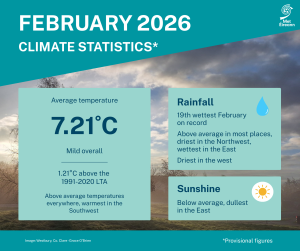
Buaicphointí Ráitis Aeráide le haghaidh mhí Feabhra 2026
Sa chéad dá thrian de mhí Feabhra 2026 leanadh leis an bpatrún céanna a bhí ann sa dara leath de mhí Eanáir den chuid ba mhó. Scairdsruth a bogadh ó dheas agus córais ísealbhrú ag bualadh bac fuar soir agus ag stad gar d’Éirinn nó thairsti. Mar thoradh ar an bpatrún sin ba mhí an-fhliuch eile a bhí inti sa Deisceart agus go háirithe in Oirthear na tíre, ach bhí sé ní ba thirime san Iarthar agus san Iarthuaisceart. Bhí báisteach an-trom san Oirthear Déardaoin an 5 agus Dé hAoine an 6 agus arís idir Dé Céadaoin an 11 agus Dé hAoine an 13, mar gheall ar chórais ísealbhrú a bhí ag teacht aniar agus ag stad thar dheisceart na tíre nó díreach ó dheas ón tír agus bhí frontaí aimsire ag teacht go mall aneas. Bhí sé ní ba shéimhe ná an meán i ngach áit agus ní ba ghruama ná an meán, go háirithe san Oirthear.
Sa trian deiridh den mhí bhog an bac fuar ar an taobh thoir amach, rud a lig do chórais ísealbhrú dul chun cinn isteach san Eoraip, agus bhog an scairdsruth beagáinín níos faide ó thuaidh. Mar gheall air sin bhí gnáthphatrún aimsire geimhridh ann a raibh tionchar an Atlantaigh air den chuid ba mhó, agus bhí ísealbhrú ó thuaidh agus ardbhrú ó dheas. Thrasnaigh roinnt bandaí báistí fronta an tír ón iarthar go dtí an t-oirthear, agus bhí roinnt ceathanna, a bhí toirniúil in amanna, agus roinnt tréimhsí tirime eatarthu.
Báisteach: Os cionn an mheáin sa chuid ba mhó d’áiteanna, ba thirime san Iarthuaisceart agus ba fhliche san Oirthear
Bhí an chuid ba mhó de na hiomláin bháistí mhíosúla os cionn a Meáin Fhadtéarmaigh (MFT) don tréimhse 1991-2020. Bhí an céatadán de na luachanna báistí míosúla idir 68% (68.1 mm) ag Marcréidh, Co. Shligigh agus 255% (133.7 mm) ag Aerfort Bhaile Átha Cliath, Co. Bhaile Átha Cliath (mí Feabhra ba fhliche ar taifead ann (fad 84 bliain)). Bhí na hiomláin bháistí mhíosúla idir 65.6 mm (105% dá MFT) ag Baile an Phaghanaigh, Co. Cheatharlach agus 149.2 mm (236% dá MFT) ag Dún Samhnaí, Co. na Mí (dara mí Feabhra ba fhliche ar taifead agus ba fhliche ó bhí 2020 ann (fad 20 bliain)). Ba é an t-iomlán báistí laethúla ab airde ná 35.3 mm ag Clár Chlainne Mhuiris, Co. Mhaigh Eo Déardaoin an 12 (an titim laethúil ab airde le haghaidh mhí Feabhra ar taifead (fad 25 bliain)).
Bhí líon na laethanta báistí* idir 21 lá ag Marcréidh, Co. Shligigh agus 27 lá ag Rinn an Róistigh, Co. Chorcaí agus ag Aerfort Chnoc Mhuire, Co. Mhaigh Eo. Bhí líon na laethanta fliucha* idir 15 lá ag Marcréidh, Co. Shligigh agus 23 lá ag Réadlann Dhairbhre, Co. Chiarraí. Ní raibh aon laethanta an-fhliuch* ag cúpla stáisiún ach bhí 5 lá den sórt sin ag Baile Uí Fhiacháin, Co. Mhaigh Eo. Chomh maith le Dún Samhnaí, bhí 2ú mí Feabhra ba fhliche ar taifead ag Páirc an Fhionnuisce, Co. Bhaile Átha Cliath tar éis mhí Feabhra 2020, áit a raibh 132.6 mm (250% dá MFT).
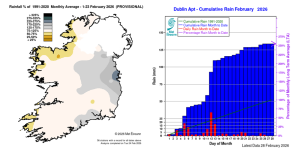
% báistí de Mheán Míosúil 1991 – 2020 le haghaidh mhí Feabhra 2026 (Sealadach) Iomláin bháistí charnacha ag Aerfort Bhaile Átha Cliath i mí Feabhra 2026. MFT 1991-2020 (luachanna 09-09)
Teocht: Os cionn an mheáin i ngach áit, ní ba theo san Iardheisceart
Bhí na meánteochtaí aeir go léir ar fud na tíre os cionn a MFT le haghaidh na míosa. Bhí athruithe ó mheánteocht an aeir idir 0.5 °C (meánteocht 6.6 °C, 7.2 °C faoi seach) ag Cionn Mhálanna, Co. Dhún na nGall agus ag Béal an Mhuirthead, Co. Mhaigh Eo, agus 2.0 °C (meánteocht 7.8 °C ) ag an gCloch Liath, Co. Chiarraí. Bhí meánteochtaí na míosa idir 5.7 °C (1.2 °C os cionn a MFT) ag Aerfort Chnoc Mhuire, Co. Mhaigh Eo agus 9.1 °C (1.7 °C os cionn a MFT) ag Réadlann Dhairbhre, Co. Chiarraí.
Tuairiscíodh an teocht ab airde sa mhí ar an gCloch Liath, Co. Chorcaí Dé Luain an 23 agus Dé Céadaoin an 25 nuair a bhí teocht 14.8°C ann. Taifeadadh íosteocht aeir ab ísle na míosa Dé Sathairn an 14 ag Marcréidh, Co. Shligigh agus ag Baile Átha an Rí, Co. na Gaillimhe, arbh ionann í agus -5.2 °C, agus bhí an íosteocht féir ab ísle a tuairiscíodh cothrom le -10.9 °C ag Marcréidh, Co. Shligigh, Dé Sathairn an 14.
Thuairiscigh gach stáisiún sioc talún i rith na míosa. Bhí líon na laethanta nuair a bhí sioc talún ann idir 2 lá ag Inis Arcáin, Co. Chorcaí agus 11 lá ag an Muileann gCearr, Co. na hIarmhí agus ag Baile Átha an Rí, Co. na Gaillimhe. Thuairiscigh níos mó ná leath na stáisiún sioc aeir. Ní raibh aon laethanta nuair a bhí sioc talún ann ag Ceann Mhása, Co. na Gaillimhe ach bhí 9 lá den sórt sin ag Cluain Creamha, Co. Ros Comáin.
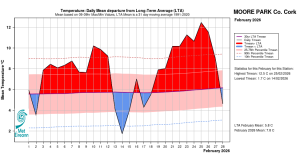
Teocht na Cloiche Léithe, Co. Chorcaí: Athrú ar mheánteocht laethúil ó MFT i mí Feabhra 2026 bunaithe ar luach Uasta/Íosta 09-09 uair.
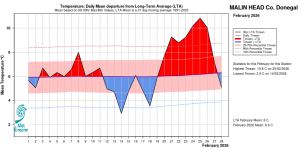
Teocht ag Cionn Mhálanna, Co. Dhún na nGall: Athrú ar mheánteocht laethúil ó MFT i mí Feabhra 2026 bunaithe ar luach Uasta/Íosta 09-09 uair
Taitneamh gréine: Os cionn an mheáin, ba ghruama san Oirthear
Bhí gach iomlán taitnimh gréine atá ar fáil os cionn a MFT. Bhí an céatadán de na luachanna taitnimh gréine mhíosúil idir 49% (36.7 uair an chloig) ag Aeradróm Mhic Easmainn, Co. Bhaile Átha Cliath (mí Feabhra ba ghruama ar taifead (fad 62 bliain)) agus 79% (55.0 uair an chloig) ag Aerfort na Sionainne, Co. an Chláir. Bhí na hiomláin taitnimh gréine mhíosúil idir 36.6 uair an chloig (Níl comparáid MFT ar fáil*) ag Aerfort Bhaile Átha Cliath, Co. Bhaile Átha Cliath (mí Feabhra ba ghruama ba fhliche ó bhí 1947 ann) agus 56.8 uair an chloig (Níl comparáid MFT ar fáil*) ag Réadlann Dhairbhre, Co. Chiarraí.
B’ionann 8.3 uair an chloig ag Aerfort Chorcaí, Co. Chorcaí Dé Domhnaigh an 1 agus an líon ab airde uaireanta taitnimh gréine laethúil a taifeadadh an mhí seo. Bhí líon na laethanta gruama* idir 11 lá ag Réadlann Dhairbhre, Co. Chiarraí agus 15 lá ag Aerfort Bhaile Átha Cliath, Co. Bhaile Átha Cliath.
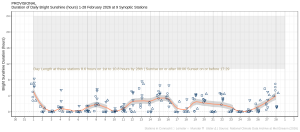
Uaireanta Taitnimh Gréine Ghil a breathnaíodh ag naoi stáisiún gach lá de mhí Feabhra 2026, curtha le chéile de réir cúige i gcoibhneas leis an líon is airde uaireanta is féidir faoi dheireadh na míosa (bosca scáthlínithe).
Gaoth: Tuairiscíodh gálaí láidre ag stáisiún amháin
Bhí na meánluasanna gaoithe míosúla idir 6.7 muirmhíle san uair (12.4 km/u) ag an gCloch Liath Co. Chorcaí agus 18.2 muirmhíle san uair (33.7 km/u) ag Cionn Mhálanna, Co. Dhún na nGall. Tuairiscíodh gálaí ar 9 lá i rith na míosa agus tuairiscíodh gaoth suas le gaotha gála láidre Déardaoin an 5 agus Dé hAoine an 6, ag Cionn Mhálanna, Co. Dhún na nGall. Bhain éagsúlacht le líon na laethanta le gálaí ó lá ar bith ag formhór na stáisiún go 7 lá ag Cionn Mhálanna, Co Dhún na nGall. Ní raibh aon laethanta nuair a bhí gaoth suas le gálaí láidre ann ag aon stáisiún seachas 2 lá ag Cionn Mhálanna, Co Dhún na nGall.
Tuairiscíodh séideán agus meánluas gaoithe 10 nóiméad ab airde na míosa ag Cionn Mhálanna, Co. Dhún na nGall Déardaoin an 5. B’ionann an séideán ab airde agus 54 muirmhíle san uair (100 km/u) agus b’ionann meánluas gaoithe 10 nóiméad ab airde na míosa agus 46 muirmhíle (85 km/u).
Both the month’s highest gust and 10-minute mean wind speed was reported at Malin Head, Co Donegal on Thursday 5th. The highest gust was 54 knots (100 km/h) while the month’s highest 10-minute mean wind speed was 46 knots (85 km/h).
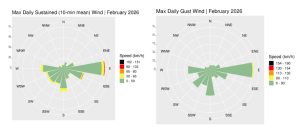
Gaothrósanna le haghaidh mhí Feabhra 2026, meán leanúnach 10 nóiméad agus séideán.
Tá tuarascáil PDF agus cairteacha ina n-iomláine ar fáil anseo
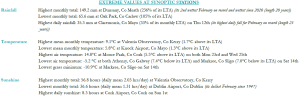
Luachanna foircneacha le haghaidh mhí Feabhra 2026 ag stáisiúin shionoptacha.
Nótaí don Eagarthóir:
- Eisithe ag Met Éireann Dé Máirt 3 Márta 2026. Tá an tuarascáil seo bunaithe ar réamhshonraí atá ar fáil ó 25 príomhstáisiún aimsire arna n-oibriú ag Met Éireann. Is í meán oíche go meán oíche AUL an tréimhse a chlúdaíonn sonraí stáisiúin shionoptacha. Tagraíonn Meánleibhéil Fhadtéarmacha (MLFTanna) agus “meán” don tréimhse 1991-2020.
- Is lá báistí é lá le 0.2 mm nó níos mó de thitim báistí. Is lá fliuch é lá le 1.0 mm nó níos mó de thitim bháistí. Is lá gruama é lá le níos lú ná 0.5 uair an chloig de thaitneamh gréine. Is lá an-fhliuch é lá le 10.0 mm nó níos mó de thitim bháistí.
- Tréimhsí tirime aeráideolaíochta – Sainmhínítear dearbhthriomach mar shraith 15 lá as a chéile nó níos mó nach dtaifeadann aon lá aonair 0.2 mm nó níos mó de fhrasaíocht. Is é páirt-triomach tréimhse 29 lá nuair nach mó an mheántitim báistí laethúil agus ná 0.2 mm. Sainmhínítear tréimhse thirim mar thréimhse 15 lá as a chéile nó níos mó, nach bhfaigheann aon cheann acu 1.0 mm nó níos mó de fhrasaíocht (i.e., an t-iomlán laethúil níos lú ná 1.0 mm).
- Tarlaíonn tonn teasa nuair a bhíonn 5 lá as a chéile nó níos mó ann a bhfuil an uasteocht os cionn 25°C (is é sin, uasteocht laethúil an aeir scáthláin > 25° C).
- Tá an tacar sonraí ‘Oileán na hÉireann’ 125 bliain ar fad agus clúdaíonn sé an tréimhse ó 1900 go 2023. Úsáidtear meáin fhadtéarmacha na tréimhse tagartha 1961-1990 mar bhonn comparáide don tacar sonraí seo, mar is gnách i measúnuithe fadtéarmacha ar an athrú aeráide.
- *Tagann sonraí gréine ón Líonra Autosol. Ní úsáidtear MLFTanna do na suímh seo faoi láthair chun críocha comparáide.
- Le haghaidh tuilleadh eolais nó chun agallamh a eagrú le hurlabhraithe Met Éireann, déan teagmháil le enq@met.ie.