A new rapid attribution study from Maynooth University, supported by Met Éireann climate scientists, has found that human-caused climate change increased both the magnitude and likelihood of the heavy rainfall that contributed to flooding in parts of the south-east of Ireland last month.
December 10th, 2025
The study examined the two-day rainfall totals associated with Storm Claudia recorded in Dublin, Wicklow and Wexford, along with 30-day antecedent rainfall across nine counties feeding into south-eastern catchments. The analysis shows that prolonged wet conditions in the months leading up to the event left soils saturated and rivers highly responsive to further rainfall.
Key findings
- The rainfall associated with the two-day event has increased in magnitude by nearly 12 percent compared with a pre-industrial climate
- 30-day rainfall events similar to those seen this autumn have increased in magnitude by nearly seven per cent
- Both the two-day and 30-day rainfall events are now twice as likely to occur as they would have been in a pre-industrial climate
- Further warming is projected to increase the intensity of similar rainfall events in Ireland, with increases expected at 1.5°C, 2.0°C and 3.0°C of global warming
Hydrometric data indicate that Storm Claudia led to significant river flooding in Wexford and Wicklow, with several gauges recording their highest or second-highest peaks on record. While moderately rare, the event occurred following several months of above-average rainfall, heightening the risk of flooding.
Paul Moore, Climatologist at Met Éireann, said that a sequence of wet months, followed by several days of active weather fronts during Storm Claudia, created the conditions for very heavy rainfall in the south-east. He noted that a warmer atmosphere can hold more moisture and therefore increases the potential for heavier rainfall when such events occur.
The study forms part of the WASITUS project, which aims to advance event attribution capability for Ireland in collaboration with the World Weather Attribution team. Event attribution analysis helps determine how climate change is influencing the likelihood and severity of significant weather events.
The project is funded by the Environmental Protection Agency and Met Éireann and is carried out by the ICARUS Climate Research Centre at Maynooth University.
For further information on this study, or the wider WASITUS project, please contact enquiries@met.ie.
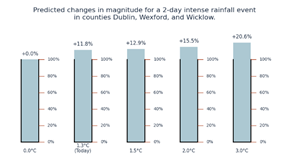
Predicted changes in magnitude for a two-day intense rainfall event in counties Dublin, Wexford and Wicklow
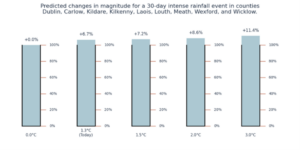
Predicted changes in magnitude for a 30-day intense rainfall event in counties Dublin, Carlow, Kildare, Kilkenny, Laois, Louth, Meath, Wexford and Wicklow
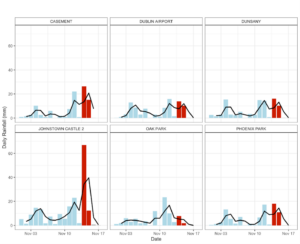
Daily rainfall totals for synoptic stations located within heavily affected counties from 1st – 17th November. Blue bars represent rainfall prior to the two-day extreme, red bars represent the two-day extreme (14th-15th) and grey bars represent rainfall after the event. The black line represents the two-day rolling average.