National May maximum air temperature record broken for Ireland as Northwest Europe sits under an intense high pressure dome (Heat Dome)
Issued: Tuesday 26 May 2026
Yesterday, Monday 25 May 2026, saw the national May maximum air temperature record being provisionally broken at various Met Éireann weather stations nationwide, with a strong chance of even higher temperatures being recorded in some parts of the country today (Tuesday).
- From our 25 synoptic stations, Shannon Airport, Co Clare reached 28.6 °C surpassing the previous May national record of 28.4 °C set in Kerry (Ardfert Liscahane) on 31 May 1997.
- From our CAMP (Climate & Automatic Monitoring Program) stations, three stations also surpassed the old record yesterday:
Killarney (Muckross House) reported 29.1 °C
Clonmel WWTP reported 29.1 °C
GLENGARRIFF (Ilnacullin) reported 29.2 °C
(these values are provisional and are subject to review and verification).
- Nine other synoptic stations also broke their station May maximum temperature records yesterday.
What is causing these high temperatures?
Northwest Europe, including Ireland, is currently sitting under an intense high pressure system that is stacked through the atmosphere with the jet stream to the north. This causes sinking air right through the layers of the atmosphere. This air compresses and warms up day on day. Other countries in northwest Europe, such as France and the UK, also broke their national May maximum temperature records yesterday, with temperatures expected to rise further today.
Climatologist Paul Moore said: “When we get a weather situation with very strong high pressure stacked through the atmosphere and sinking air over several days, the maximum temperatures reached can be higher than similar situations in the past, due to the increased background warming caused by climate change.”
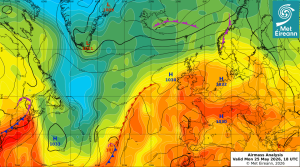
Airmass Analysis chart 18 UTC 25 May 2026: High pressure dominating northwest Europe with very warm airmass extending over Ireland.
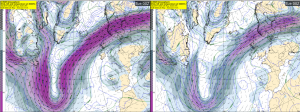
ECMWF upper air charts 300 hPa and 500 hPa showing high pressure extending though the atmosphere.
Is Climate Change a factor?
- Climate change has increased the frequency and intensity of extreme weather events. As global temperature increases, heat extremes are likely to be warmer and more frequent.
- Ireland’s average temperature has increased by approx. 1.1°C since 1900.
- While Europe is warming at twice the global average rate, Ireland’s warming is not as fast due the prevailing influence of the Atlantic Ocean.
- The last time in Ireland we saw temperatures widely above 25 °C was 12/13th-August last year (2025). The highest temperature during that spell was 28.1°C at Shannon Airport, Co Clare on Tue 12th.
- Ireland’s average temperature is expected to further increase into the future due to climate change. This further increases the risks of more frequent and extreme heat events.
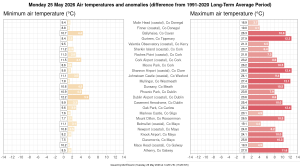
Monday 25 May 2026 Air temperatures and anomalies at synoptic stations (difference from 1991-2020 long-term average period)