The climate phenomenon known as El Niño has gained extensive media attention over recent days. Here, Met Éireann experts explain what El Niño is, and its influence on Irish weather and climate.
What is El Niño?
El Niño refers to warm surface waters in the Eastern tropical Pacific that were first observed in the disruption of fish stocks for Peruvian fishermen several centuries ago. The name comes from the Spanish word for ‘boy’, with the opposite phenomenon, i.e. cold and nutrient rich waters upwelling to the surface of the Eastern tropical Pacific, known as La Niña, the Spanish for ‘girl’.
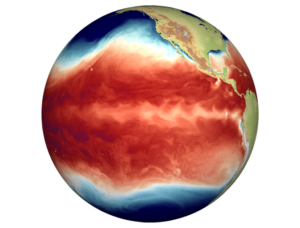
Fig 1: A snapshot of eastern Pacific sea surface temperatures, showing temperature pattern for a typical La Niña event, with equatorial cold temperatures and wave-like structure west of the Galapagos Islands simulated by a high-resolution climate model. Blue to red colour shading indicates transition from colder to warmer surface conditions. The amplitude of La Niña and El Niño conditions can intensify in response to global warming and the succession of these extremes will also become more regular
In a climatic context, we refer to the El Niño phenomenon as the oscillation between warm Eastern tropical Pacific sea surface temperature conditions (El Niño) and cold Eastern tropical Pacific sea surface temperature conditions (La Niña). This natural fluctuation between the two conditions influences weather and climate worldwide, with the entire oscillation process taking up to a few years in time.
Influence on global and Irish weather and climate
The global mean temperature tends to be higher than average under El Niño conditions, usually with a time lag of several months. The currently developing strong El Niño has the potential, together with the underlying global warming trend, to lead to record high global mean temperatures in the second half of 2026 and in 2027, and to extreme weather events.
While El Niño has clear impacts on many regions worldwide through teleconnections (for example affecting monsoon systems), its influence on Ireland and Europe is comparatively weak, highly variable, and not robust in the present-day climate.
The global seasonal climate update of the World Meteorological Organization for this summer points in the same direction, i.e. no clear evidence of increased warming in Ireland due specifically to El Niño. In a future warmer climate, El Niño may have a greater influence on Irish and European climate according to recent studies, but that would only materialise in the second half of this century under higher greenhouse gas scenarios.
For more, visit: Met Éireann contributes to publication on future development of El Niño and its relevance to Europe